Work With Me
Building a Bridge Between East and West Through Our Shared Human Heritage
Four Pathways to Collaboration
Where research, philosophy, art and human experience meet to create new perspectives across cultures and disciplines.

Speaking & Thought Leadership
Ideas that open new ways of seeing the human experience.
- Keynotes, panels, conferences and philosophical conversations exploring identity, consciousness, power, the Feminine and Masculine, wholeness and human transformation.
- Talks that bring psychological, philosophical and symbolic perspectives into dialogue, creating space to question assumptions rather than simply confirm existing ones.
- International conversations for audiences interested in cross-cultural understanding, human dignity, meaning and the deeper questions of what it means to be human.
Best suited to: conferences, universities, philosophical societies, cultural institutions and interdisciplinary events.

Research & Academic Collaboration
Exploring questions that sit between disciplines, cultures and forms of knowledge.
- Collaborative research developing questions at the intersection of psychology, philosophy, sociology, symbolism, art and human experience.
- Comparative and cross-cultural projects exploring how different traditions understand identity, consciousness, embodiment, transformation, belonging and wholeness.
- Opportunities to develop the Grail Principle and the East–West Bridge through dialogue with researchers, academic institutions and other knowledge traditions.
Best suited to: universities, research centres, psychology and philosophy departments, Jungian/depth-psychology communities and interdisciplinary researchers.
Workshops & Creative Exploration
Using reflection, symbolism and creative practice to investigate the questions beneath the surface.
- Experiential workshops exploring identity, archetypes, symbolism, storytelling, meaning and cross-cultural understanding.
- Creative and reflective processes that invite participants to examine the identities, assumptions and inherited narratives through which they understand themselves and the world.
- Spaces where mind and heart, analytical thought and symbolic imagination, individual experience and collective meaning can meet.
Best suited to: educational settings, cultural organizations, community groups, professional development and interdisciplinary programmes.
Art & Visual Projects
Art as a language through which complex human questions can become visible.
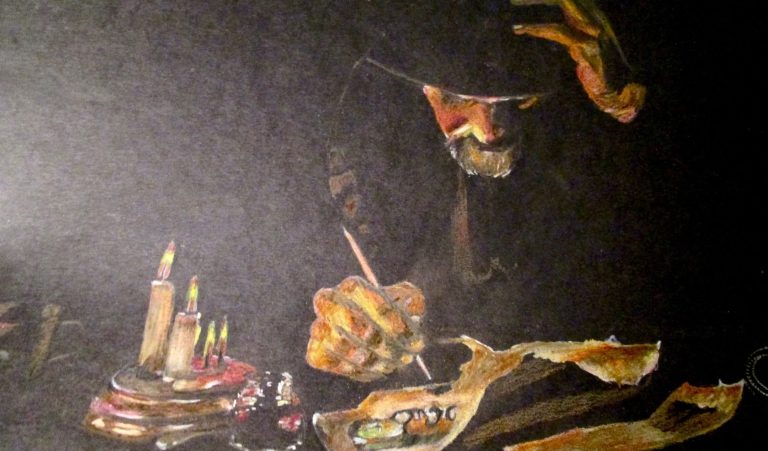
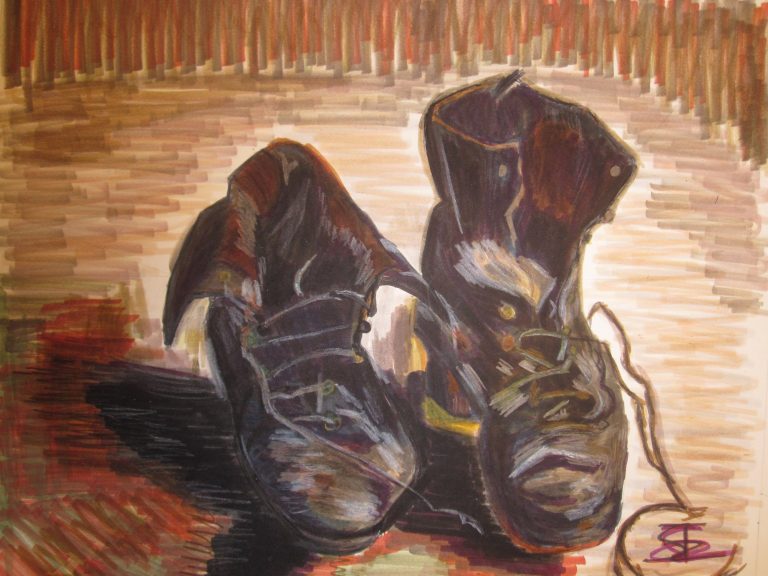
- Commissioned artwork, exhibitions and visual storytelling developed around human dignity, identity, transformation, Feminine and Masculine symbolism, memory and meaning.
- Visual projects that translate philosophical or psychological ideas into images, narratives and symbolic forms.
- Collaborative projects connecting art with research, advocacy, cultural dialogue and storytelling, allowing visual language to communicate what conventional academic language sometimes cannot.
Best suited to: exhibitions, cultural institutions, publications, campaigns, research projects and collaborative artistic initiatives.
Selected International Conversations & Collaborations
Malaysian Interview about Femininity
The first Malaysian interview explored the early formation of the Grail Principle, a developing framework examining the relationship between feminine and masculine dimensions of human experience. At the heart of the discussion was the threefold nature of the feminine individual — Maiden, Mother and Crone — with particular emphasis on the Crone as an embodiment of wholeness, maturity and integrated feminine consciousness. The conversation drew on Marion Woodman and Elinor Dickson’s Dancing in the Flame and marked an early stage in the development of this idea.

The Netherlands discussion on Perennial Philosophy
The Netherlands interview explored the contrast between René Descartes and Carl Jung, examining the differences between rational thought and the deeper dimensions of human experience. The conversation considered how the world opens beyond the boundaries of reasoning, and what may lie behind the limitations of the human mind — inviting a broader understanding of consciousness, perception and existence.
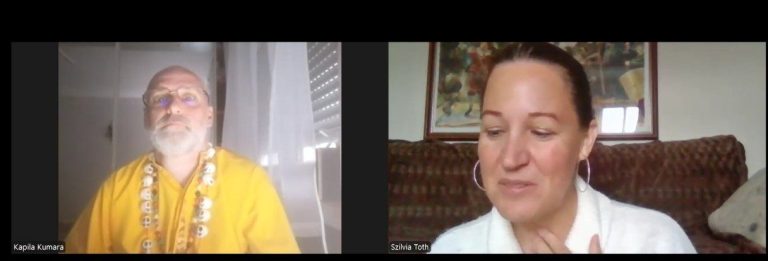
Hungarian discussion about Perfection and Wholeness with Kapila Kumara
The Hungarian-language discussion with Kapila Kumara explored the tension between perfection and wholeness, asking whether the human journey is truly about becoming “perfect” or discovering a wholeness that is already present. The conversation approached this question primarily through Jungian psychology — exploring the Self, shadow integration, individuation, anima and animus, the body and creative experience — while contrasting these ideas with the Vedic concept of Pūrṇatva, wholeness as something already given. It also examined the psychological limits of the pursuit of spiritual perfection and whether fragmentation, contradiction and imperfection may themselves belong to the experience of becoming whole.
Hungarian discussion about Near Death Experience with Kapila Kumara
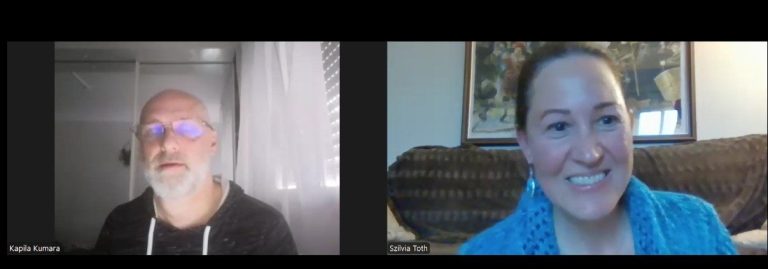
This Hungarian-language discussion with Kapila Kumara, with English subtitles, explores the inner reality of near-death experiences from a Jungian psychological perspective, contrasted with Vedic teachings. The conversation examines what may happen within consciousness at the threshold of death, including experiences of light, timelessness and “returning home”, alongside Jungian symbolism and archetypes of death, transformation and rebirth. It also considers the profound changes in identity and values that can follow an NDE, opening a dialogue between Western depth psychology and the Vedic understanding of consciousness.
Sociological Association of Ireland: The Silver Lining in the Power Dynamic - From Individualism Forward Solidarity
Abstract submission exploring power, resistance and solidarity in the context of Palestine, drawing on Michel Foucault and interdisciplinary psychological and sociological perspectives. The research examines how digital activism and global resistance challenge traditional understandings of power and proposes solidarity, empathy and mutual support as an alternative ethical framework.
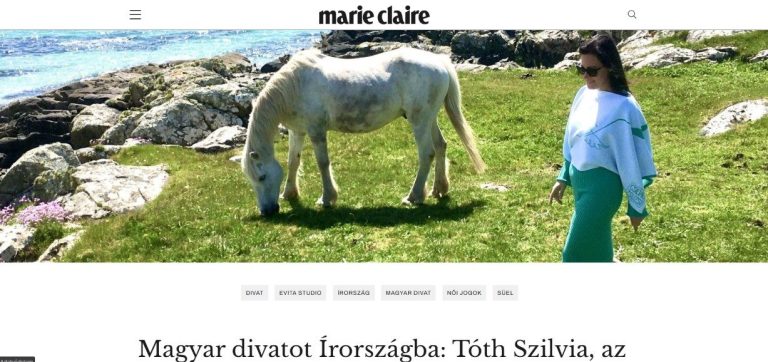
Interview with Marie Claire
The Marie Claire interview traces Szilvia’s journey from law and aviation to human rights advocacy and life in Ireland, alongside the creation of Evita Studio as a bridge between Hungarian and Irish culture through fashion. At its heart is a wider vision of dignity, equality and the integration of body, mind and heart
The Grail Principle
From the Hero Journey to the Geometry of Home
The Feminine Principle of Holding, Integration and Home
THE CENTRAL DISTINCTION
The Hero changes the world through movement; the Grail changes the world through presence. The Hero is a vector — arrow, reach, departure, confrontation and the search for treasure. The Grail is a field — a living centre that holds, receives, connects, integrates, remembers and nourishes.
The Hero asks: How far can I go? What dragon must I defeat? The Grail asks: How much can I hold without breaking?
The deeper question: What kind of human being does one become after integrating multiple worlds?
HOME AS THE GRAIL
The Grail makes Home capable of holding the treasure. Home is not simply a physical place, but the meaning-making centre around which movement remains possible.
The centre was always the original memory of Home. The journey is NOT the discovery of the world but the rediscovery of the meaning of HOME.
The centre is the meaning-making. Home is a place where all apparent opposites are finally reconciled without one destroying the other — where belonging is possible without abandoning oneself.
Grail is asking:
• What is Home?
• What is truth?
• What remains of the identity after reputation is stripped away?
• Can love survive betrayal?
• Can vocation survive fear?
• What does it mean to belong without abandoning oneself?
THE GEOMETRY OF THE GRAIL
The geometry through which meaning is presented while consciousness moves. The Grail is not a fixed endpoint: its geometry expands in concentric circles around the centre, while consciousness spirals into the centre of the Self.
• Arboreal movement — growth happens simultaneously in opposite directions. The deeper one descends into truth, the further one can reach into the world.
• Bidirectional movement — roots and crown, depth and expansion, inner and outer remain one living structure.
• Labyrinth — returning to the centre through Home, Love, Identity, Voice, Truth and Belonging.
The task is to maintain the integrity of the center while consciousness expands.
THE LIVING CENTRE
• Bone Collector — gathers discarded bones of what has been forgotten, preserves dignity, finds pattern and sings life back into what might otherwise disappear. She stays, gathers, remembers, restores and reconnects.
• Penelope — the invisible queen whose weaving embodies continuity. While the Hero journeys outward, she maintains the inner kingdom and preserves the possibility of return.
The Grail is a living process — transmuting, transcending, nourishing, integrating, remembering, never ending. It is the living centre around which movement remains possible.
II. BUILDING THE BRIDGE BETWEEN EAST AND WEST
THE METHODOLOGY The East–West Bridge is the methodological dimension through which the Grail Principle is developed: a field in which distinct cultural, intellectual and symbolic perspectives enter genuine dialogue around shared human questions without being reduced to one another.
• Why dialogue? Because the questions at the centre of the Grail Principle cannot be fully explored from a single cultural or intellectual position. Dialogue allows apparently separate worlds to remain distinct while illuminating one another.
• The practice — translation, comparison and relationship across philosophical, psychological, symbolic and cultural traditions, asking what becomes visible when different forms of human knowledge are held together.
• The connection — The Grail Principle identifies the centre that holds; the East–West Bridge provides the field of dialogue through which that principle can be investigated, tested and further developed.
IN DIALOGUE WITH EXISTING FRAMEWORKS
• Joseph Campbell — the Hero Journey maps transformation through departure, initiation and return; the Grail Principle asks what holds the centre while that movement takes place.
• Ken Wilber — Integral approaches explore development and the integration of multiple dimensions and levels; the Grail Principle focuses on the centre that can hold multiplicity without destroying relationship.
• Carl Jung — individuation concerns the integration of conscious and unconscious dimensions; the Grail Principle asks what symbolic Home can hold the worlds encountered through that process.
• Clarissa Pinkola Estés — the Life–Death–Life cycle illuminates regeneration and the feminine psyche; the Grail Principle places emphasis on the living centre that preserves continuity through transformation.
WHAT HOLDS THE WORLD TOGETHER WHILE CONSCIOUSNESS EVOLVES?